Over ons 🤖

Laten we elkaar leren kennen

Vertel me de missie en visie

Leg het verhaal achter Mach8 uit

Hallo daar 👋

Hoe kunnen we je helpen?

Mijn gegevens mogen worden gebruikt om me op de hoogte te houden van relevant nieuws van Mach8

Company OS

Buy the infrastructure. Build the rest.

Custom software on top of your core SaaS: one operating system of your own for how your company works.

The problem

Companies run on a patchwork of tools

305SaaS applications managed by the average company
40apps used by the average employee
9×a day employees switch between apps

Every tool sells an average process. Your team glues the data together in between.

Sources: Zylo SaaS Management Index 2026, Torii SaaS Benchmark 2026, Asana Anatomy of Work

What changed

Building custom software no longer takes months, but days

3 mo → 3 daysWhat used to be a quarter of development for us now takes days
35%of enterprise teams already replaced at least one SaaS tool with their own software
78%expect to build more internal tools in 2026

Source: Retool, Build vs. Buy Report 2026 (n=817)

The insight

Software has two layers. Buy one, build the other.

Core infrastructure · buyCommodity, compliance, scaleEmail, calendar and documents. Accounting, ERP, payments, identity. Here you want an established vendor with security, SLAs and certifications.
Work layer · buildYour process, your edgePlanning, quotes, sales, reporting, client portals, AI agents. This is how you work, and today you pay per seat for someone else’s average.
What it looks like

One OS on top of the systems you already have

PeopleOne interface per role: project lead, sales, finance, management
Your OSCustom modules and AI agents for your processes
Integration and data layerAPIs, sync, one data model, permissions and logging
Core SaaSGoogle Workspace or M365 · accounting · CRM database · ERP
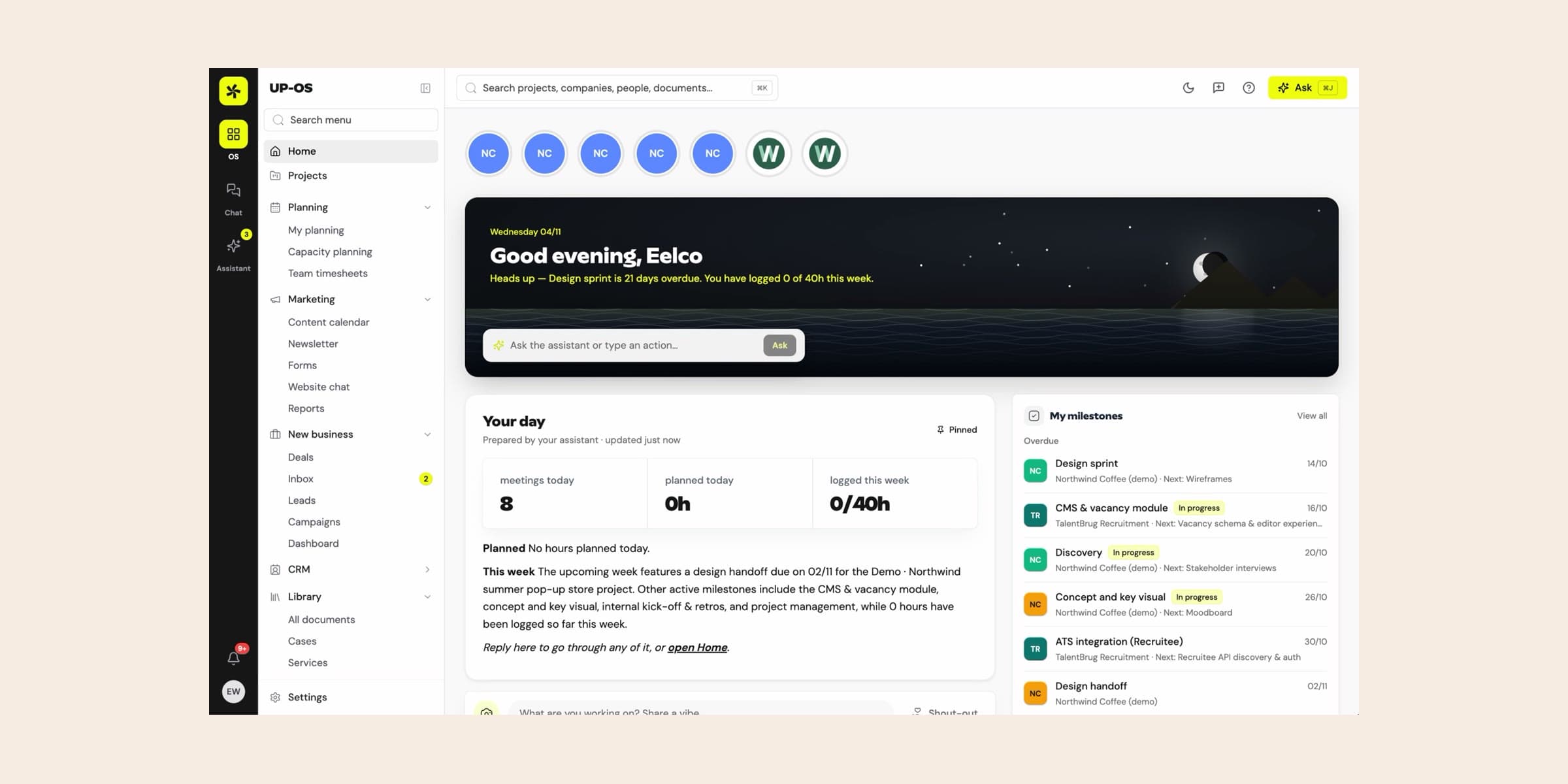
The proof · UP-OS

We did it ourselves first

United Playgrounds, the group Mach8 is part of, runs on an operating system of its own. Every agency in the group uses it. It runs on email, Drive and calendar as its core, and replaces the separate tools we used before.

What it replaces
  • Teamleaderfully
  • Forecastfully
  • Sales toolsfully
  • HubSpotpartly
UP-OS
What you get

Software that adapts to the business, not the other way round

Fits your processNo more workarounds around a standard tool.
Fewer licencesSeparate tools and seats out, one platform in return.
AI in the workflowAgents that do work on your own data, not a chat window next to it.
One source of truthProjects, hours, sales and clients in one data model.
What we do and don’t touch

Replace, connect or leave in place

Replace
  • Planning and resourcing
  • Time tracking
  • Quote and sales tools
  • Internal dashboards
  • Workflow automation
Connect
  • CRM
  • Accounting
  • Email, calendar, Drive
  • HR and payroll
Leave in place
  • ERP core
  • Payments
  • Identity and security
Approach

Start small, run in shadow, then switch

01OS scan1 weekTool inventory, licence costs, processes. A shortlist of what we replace.
02First module2–4 weeksOne process built on the core systems, tested with the team in short cycles.
03Shadow and roll-out1–2 monthsRun next to the old tool, then move over team by team. Cancel the licence only once it works.
04Keep developingOngoingNew modules and agents every quarter. The OS grows with the business.
Commercial model

Pay for what you build, not per seat

EntryOS scanFixed priceDelivers a business case per tool.
BuildPer moduleFixed priceFixed price per module, no hours budget.
Run and evolveSubscriptionPer monthHosting, maintenance and new features. Below the cancelled licences.
Who it is for

Companies growing faster than their tools

Profile
  • 50 to 500 employees
  • Project-based or service-oriented
  • Their own way of working as a differentiator
  • Already on Google Workspace or M365
Sound familiar?“We pay for twenty tools and use a third of each.”“My team glues data between systems.”“Our process doesn’t fit the standard tool.”

The questions every CTO asks

Question not listed? Ask it in a process call

The run subscription: fixed points of contact and agreements on availability. Hosting, maintenance and new features are included.

The OS first runs in shadow next to the old tool. That tool only goes once the new one works, team by team.

Data stays in your core systems, such as Google Workspace, M365 and your accounting. We build on top, with permissions and logging.

Code ownership and an exit arrangement are agreed upfront, before we build.

Next stepOne week scan. One process live. Then you decide.We start with the OS scan: an overview of your tools, what they cost and which ones we replace first.
Company OS - MACH8 | Buy the infrastructure. Build the rest.